AAIMP, Port Harcourt, Nigeria | +234 806 815 3116 | +2340 806 335 4768

what we do
Events
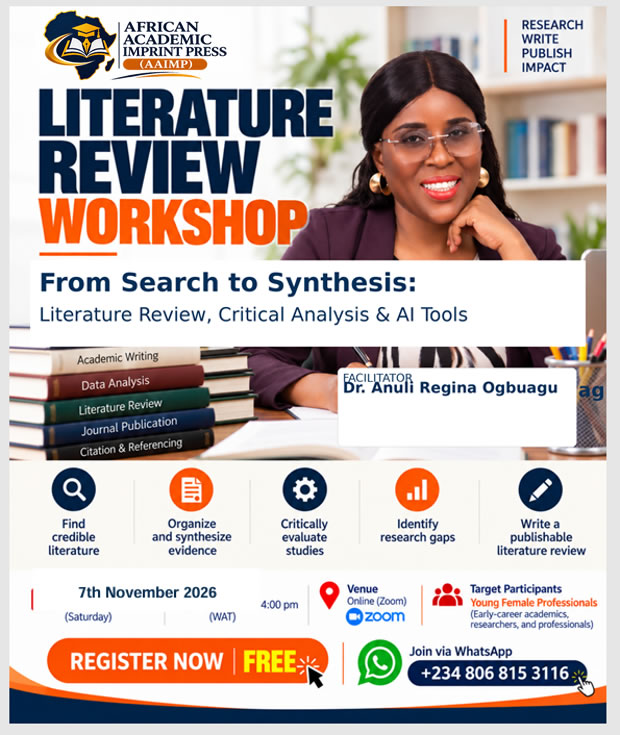
LITERATURE REVIEW WORKSHOP: FROM SEARCH TO SYNTHESIS
Literature Review, Critical Analysis and AI Tools
Overview of the Workshop
The African Academic Imprint Press (AAIMP) held a virtual workshop titled Literature Review: From Search to Synthesis – Literature Review, Critical Analysis and AI Tools on Saturday, 7 November 2026.
Facilitated by Dr. Anuli Regina Ogbuagu, FNES, FERIN, FAIPL, the workshop brought together academics, early-career researchers, young female professionals and other participants interested in improving their research and academic writing skills.
The workshop focused on the principles and processes of conducting a rigorous literature review, from identifying relevant scholarly publications to critically evaluating existing studies, synthesising research findings and identifying gaps that justify further investigation.
The facilitator emphasised that a good research project begins with a well-developed literature review. Researchers must demonstrate an understanding of existing knowledge, identify areas requiring further investigation and establish how their studies contribute to ongoing academic discussions.
Organized by
African Academic Imprint Press (AAIMP)
Date & Time
Sat, 7 November 2026 4:00 PM (WAT)
Facilitator
Dr. Anuli Regina Ogbuagu, FNES, FERIN, FAIPL
Venue
Online (Zoom)
Literature Review Workshop:
Major Areas Covered
The workshop examined the meaning and purpose of a literature review as a critical evaluation and synthesis of existing scholarly works. Participants were encouraged to move beyond describing previous studies and instead examine how different studies relate to one another, where their findings agree or differ, and what questions remain unanswered.
Three major components were discussed:
- Conceptual Literature Review
This involves examining the major concepts, definitions, variables and relationships relevant to a research topic. The facilitator explained the importance of clarifying research concepts and using conceptual diagrams where necessary to illustrate relationships among variables.
- Theoretical Literature Review
This examines the theories relevant to a research problem. It includes the origins of theories, their proponents, assumptions, applications, strengths and limitations. Participants were encouraged to select theories based on their relevance to the research problem rather than merely listing available theories.
- Empirical Literature Review
This involves examining previous research studies, paying attention to their objectives, theoretical foundations, methodologies, findings and conclusions. The facilitator stressed the importance of critically comparing previous studies and establishing their relevance to the research being undertaken.
The relationship between theoretical review and the development of a theoretical framework was also discussed, particularly the role of relevant theories in providing a foundation for hypothesis development and testing.
Participants were introduced to a structured seven-step process for conducting a literature review, beginning with defining the research scope and proceeding through literature identification, screening, evaluation, synthesis, and manuscript preparation.
Different approaches to reviewing literature were also examined, including:
- Chronological review
- Thematic review
- Methodological review
- Theoretical review
- Comparative review
- Integrative review
- Systematic review
- Narrative review
- Scoping review
The facilitator explained that the choice of approach should depend on the research objectives, scope, and nature of the available literature.
The workshop introduced participants to academic databases and research platforms for locating scholarly publications.
Primary academic databases:
- Scopus
- Web of Science
- EconLit
- ScienceDirect
Supplementary research platforms and databases:
- Google Scholar
- ResearchGate
- Academia.edu
- EBSCOhost
- ProQuest
- African Journals Online (AJOL)
- OpenAlex
Participants were introduced to effective literature search strategies, including the use of keywords, Boolean operators (AND, OR and NOT), publication date filters, and inclusion and exclusion criteria.
The importance of selecting credible and relevant academic sources was emphasised.
A major part of the workshop focused on the difference between summarizing literature and synthesizing research evidence.
Participants learned that synthesis requires researchers to bring together findings from different studies, compare their approaches, examine similarities and differences, and develop a coherent understanding of the existing body of knowledge.
The facilitator introduced the literature review matrix as a practical tool for organizing scholarly publications. The matrix helps researchers record and compare authors, publication years, theories, research methods, variables, and findings.
It was emphasized that the matrix is a preparation and analytical tool. It does not replace the actual written empirical literature review.
Four major categories of research gaps were discussed:
- Empirical gap: Arises when existing studies have not adequately investigated a particular research problem or relationship.
- Theoretical gap: Occurs when existing theories do not sufficiently explain a research phenomenon or when alternative theoretical perspectives are required.
- Methodological gap: Arises from limitations in the methods, models, techniques, or research designs adopted in previous studies.
- Inconsistency gap: Occurs when previous studies produce conflicting or contradictory findings that require further investigation.
Other dimensions of research gaps, including conceptual, temporal, and spatial gaps, were also highlighted.
Integer at faucibus urna. Nullam condimentum leo id elit sagittis auctor. Curabitur elementum nunc a leo imperdiet nec elementum diam elementum. Etiam elementum euismod commodo. Proin eleifend eget quam ut efficitur. Mauris a accumsan mauris. Phasellus egestas et risus sit amet hendrerit. Nulla facilisi.
KEY LESSONS
Key Lessons from the Workshop
The workshop highlighted several important principles for effective academic literature reviews:
- A literature review should critically evaluate and synthesize existing studies rather than merely summarize them.
- Every research project should be grounded in relevant conceptual, theoretical and empirical literature.
- Researchers should use credible academic databases when sourcing scholarly publications.
- A literature review matrix can improve the organization and comparison of research findings.
- Research gaps must be clearly established and supported by evidence from previous studies.
- The choice of literature review methodology should reflect the objectives and scope of the research.
- AI tools can support literature discovery and synthesis, but their outputs must be independently verified.
- Researchers must maintain academic integrity and take responsibility for the accuracy of their work.



Testimonials
Client’s support is the Best Reward
In consequat, quam id sodales hendrerit, eros mi leo, nec lacinia risus neque tristique augue. Proin tempus urna vel congue elementum. Vestibulum euismod accumsan duiac iaculis sem
Jiza Sikuanza

In consequat, quam id sodales hendrerit, eros mi leo, nec lacinia risus neque tristique augue. Proin tempus urna vel congue elementum. Vestibulum euismod accumsan duiac iaculis sem
Peter Monier

In consequat, quam id sodales hendrerit, eros mi leo, nec lacinia risus neque tristique augue. Proin tempus urna vel congue elementum. Vestibulum euismod accumsan duiac iaculis sem
Sara Carter

Our Newsletter
Enter your email address to be updated with fresh news
Receive emails updates and hot offers
Our Newsletter
Enter your email address to be updated with fresh news
Receive emails updates and hot offers